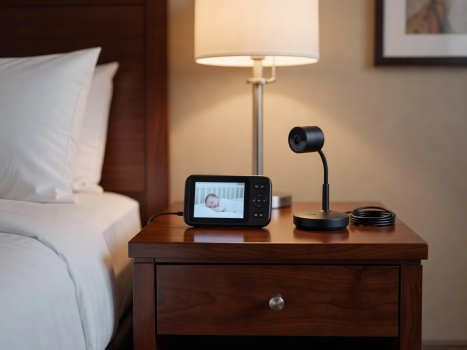
Whether you are heading to a hotel for a summer vacation, staying at a rental cabin, or simply visiting the grandparents for a weekend, maintaining your child’s sleep routine in unfamiliar environments is notoriously difficult. A reliable travel baby monitor helps ease this transition by providing the same reassurance you rely on at home.
The Problem with Home Monitors on the Road
Many parents attempt to pack up their primary nursery monitor when traveling, only to discover it is wholly unsuited for the task. Wi-Fi monitors are particularly problematic in hotels or resorts; these public networks often utilize "captive portals" (a web page where you must agree to terms or enter a room number before accessing the internet). Most smart cameras lack web browsers and simply cannot connect to these networks.
Traditional dedicated video monitors work well without Wi-Fi, but their cameras are often bulky, meant to be permanently screwed into a wall, and require the camera unit to be constantly plugged into a wall outlet—which might not be conveniently located near the travel crib.
Key Features of a Travel Monitor
A specialized travel monitor or a secondary, portable unit solves these common travel frustrations. When looking for a travel monitor, prioritize the following features:
- Battery-Operated Camera: The defining feature of a great travel monitor is a camera that can operate on battery power. This allows you to place the camera anywhere in the room, regardless of outlet location. While battery life won't last forever, a camera that can run for 4 to 8 hours unplugged is perfect for nap times or covering the evening gap before you go to bed.
- Compact and Lightweight Design: Luggage space is at a premium when traveling with an infant. Travel monitors are designed to fold flat or are built in compact cylinders, ensuring they tuck easily into a diaper bag.
- Mounting Flexibility: Because you cannot drill into hotel walls, travel cameras often feature flexible, bendable stands (similar to a tripod) or strong clamps. This allows you to attach the camera to a door frame, a curtain rod, or the edge of a pack-and-play.
- Direct Connection: The system must operate on a closed-loop frequency (FHSS or similar) so that it connects to its parent unit the instant it is turned on, without requiring any network configuration.
Audio vs. Video for Travel
If budget or packing space is extremely tight, a simple, inexpensive audio monitor is often the best travel companion. They are incredibly small, practically indestructible in a suitcase, and provide robust connectivity that easily punches through the thick doors of a rental house. Because you are often sleeping in closer proximity to the baby while traveling, merely hearing them stir is usually sufficient.
Durability and Protective Cases
Travel gear takes a beating. Look for monitors built with durable plastics that can survive being dropped onto a hotel room floor. If you are investing in a dedicated travel unit, it is highly recommended to purchase a hard-shell protective carrying case. These cases organize the camera, the parent unit, and the charging cables, preventing screens from cracking when compressed in an overhead bin.
Conclusion
A travel monitor reduces the friction of parenting on the go. By investing in a device that offers battery flexibility, versatile mounting options, and independence from complex Wi-Fi networks, you can ensure that nap times remain protected and evenings remain relaxing, no matter where your travels take you.