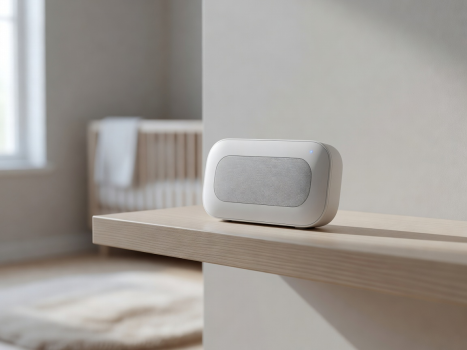
In an era dominated by high-definition video, smartphone applications, and smart home integrations, it might seem surprising that the traditional audio-only baby monitor still commands a significant share of the market. Yet, for many families, audio monitors provide exactly what they need without the added cost, complexity, and battery drain of video systems.
The Power of DECT Technology
While early analog audio monitors were notorious for picking up interference from cordless phones or even neighboring houses, modern audio monitors rely on DECT (Digital Enhanced Cordless Telecommunications) technology. Originally developed for landline cordless telephones, DECT operates on the 1.9 GHz frequency band, entirely separate from the crowded 2.4 GHz band used by Wi-Fi routers, microwaves, and Bluetooth devices.
This separation makes DECT incredibly reliable. It provides a secure, encrypted connection that guarantees you are the only one listening to your baby, and it eliminates the frustrating static and cross-talk of older analog models. The sound transmission is crystal clear, allowing you to easily distinguish between a baby's active sleep noises and genuine distress.
Unmatched Battery Life
One of the most significant drawbacks of video monitors is their voracious appetite for power. Pushing video signals to a backlit screen drains batteries quickly. Audio monitors, by contrast, are incredibly power-efficient.
The parent units of most audio monitors can last anywhere from 18 to 24 hours on a single charge. This means you can clip the receiver to your belt in the morning, wear it around the house all day, and still have battery left by evening. Some models even take standard AA or AAA rechargeable batteries, meaning you can easily swap them out if the internal cells degrade over years of use.
Visual Sound Indicators
A common concern with audio monitors is how useful they are in noisy environments, such as when you are vacuuming, watching television, or entertaining guests. Manufacturers solved this long ago by incorporating visual sound level indicators.
Most parent units feature a row of LED lights along the top or front panel. The louder the noise in the nursery, the more lights illuminate, often shifting from green to yellow to red. This simple visual cue allows you to "see" your baby's cries even when the parent unit's volume is muted or drowned out by background noise.
Additional Features
Modern audio monitors are far from basic. Many include features designed to soothe the baby and assist the parent without complicating the core function:
- Two-Way Talk: A built-in microphone on the parent unit allows you to press a button and speak to your baby. The sound of a parent's voice is often enough to settle a child without needing to enter the room.
- Temperature Sensors: A sensor on the baby unit monitors the nursery temperature, displaying the reading on the parent unit and sometimes offering alerts if the room gets too hot or too cold.
- Nightlights and Lullabies: Many base units feature soft, glowing nightlights and can play a selection of built-in lullabies or white noise, controllable directly from the parent unit.
Why Choose Audio?
The primary advantage of an audio monitor is its sheer reliability. There are no apps to crash, no Wi-Fi networks to drop, and no complex settings to configure. You plug it in, turn it on, and it works.
Furthermore, many parents find that video monitors can actually increase anxiety. Constantly watching a screen to see if a baby has shifted positions can lead to lost sleep for the parents. Audio monitors promote a "listen-only" approach, encouraging parents to respond to auditory cues of distress rather than visual restlessness.
When combined with their affordability, robust build quality, and superior range (often penetrating walls better than 2.4 GHz video signals), audio monitors remain an excellent, distraction-free tool for modern parenting.